
Clients trust you to help them look their best, relax, and unwind. That trust extends to how you handle their information, as well. Even solo practitioners manage addresses, payment info, and intake forms online — all of which are susceptible to cyberattacks.
Learn how to keep client data safe, plus the number-one way to protect your business against data breach claims. (Hint: it’s called cyber liability insurance!)
Did you know?
You’re never too small to protect yourself against cybersecurity risks. 46% of small and medium-sized businesses have experienced a cyberattack, and nearly one in five of those attacks led to bankruptcy or closure. Keeping data safe benefits your business and the clients you serve.
What Counts as “Client Data” in Beauty or Bodywork Businesses?
Client data = client information.
In any industry, including beauty and bodywork, client data refers to client-related information you collect, store, or process in the course of operating your business. If it’s attached to a client and you interact with it for business purposes, it’s client data!
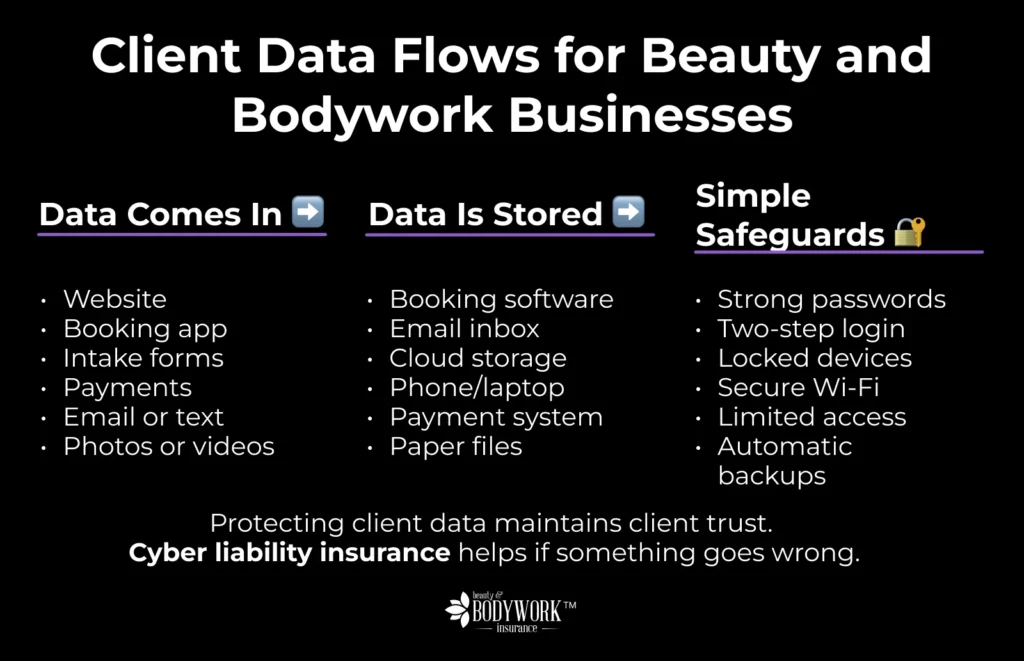
For many beauty and bodywork professionals, client data includes:
- Contact information (phone numbers, addresses, and emails)
- Payment information (credit card numbers or PayPal accounts)
- Health and personal details on intake forms
- Images and videos (like before-and-afters)
- Login credentials for booking systems
- Booking/calendar information
- Digital and physical records
- Session notes
Most of the above is considered personally identifiable information (PII), which is any data that can be used to identify someone. No one wants their personal details floating around on the internet. That’s why it’s crucial to protect client privacy by keeping their information secure.

Common Ways Client Data Gets Compromised
Client data can be compromised at any stage. Here are some of the most common online attacks on solo beauty and wellness businesses.
Swipe →
| Online Attack | How It Works | Why It’s Risky for Client Data |
|---|---|---|
|
Phishing emails |
Fake emails or texts trick you into clicking links or sharing login info |
Attackers can access booking systems, email accounts, or client files |
|
Weak passwords |
Simple or reused passwords are easy to guess or crack |
Hackers can log in and download client data |
|
Malware |
Harmful software is installed through downloads or links |
Can steal client info or lock files until a ransom is paid
|
|
Unsecured Wi-Fi |
Using public or unprotected networks |
Attackers can intercept data being sent or received |
|
Hacked social accounts |
Business social media accounts are taken over |
Private messages, photos, or client conversations can be exposed
|
Say you need to check your upcoming appointments while grabbing your morning coffee. You connect to the cafe’s Wi-Fi on your smartphone, unaware that someone is waiting to intercept your booking system and steal your clients’ credit card information. It can happen to anyone!
Online attacks become more sophisticated every day. And unfortunately, many hackers target solo practitioners who are lax about cybersecurity because of the false perception that their businesses are “too small” or “not worth it.”
Your offline, or physical, data is also at risk of being stolen. These breaches can be caused by something as simple as leaving paper files unsecured or sharing devices with staff or other contractors.
Pro Tip:
Booking online is the most preferred method among clients (47.5% surveyed say so!). That means keeping up with client expectations by offering online booking — and protecting their data while doing so — is a given. See more of BBI’s exclusive industry insights.

How to Keep Client Data Safe From Online Attackers
You may not be able to physically see online attackers, but you can take practical steps to keep client data safe from cybersecurity threats. Here are some smart ways to protect the information clients trust you with.
1. Use Strong Passwords and Multi-Factor Authentication
The same “weak” password that you use for all your accounts, from your personal email to your point-of-sale (POS) system? Get rid of it!
Weak or reused passwords are one of the most common entry points for hackers. Update your passwords to be strong (e.g., a combination of words, a number, and a unique character).
Best Practices:
- Use a free password manager, like Proton Pass or Google Password Manager, to create and store strong passwords
- Create unique passwords for every system, including your email, booking software, cloud storage, and point-of-service (POS) platform.
- Turn on multi-factor authentication (MFA), which requires you to confirm your identity on another app or device, when it’s available
If your password is stolen, MFA can help prevent attackers from accessing your client data.
2. Secure Your Devices and Wi-Fi
How many devices and Wi-Fi networks do you use in your day-to-day operations? Each phone, tablet, laptop, and network is an opportunity for attackers to breach data, so it’s crucial to secure each one!
Best Practices:
- Always enable lock screens on devices with a PIN or password
- Install software and security updates as soon as they’re available
- Only use encrypted Wi-Fi; avoid public networks for work
Though it can be tempting to keep your phone unlocked or connect to whatever Wi-Fi is available, remember that hackers look for easy opportunities like these to strike.
3. Be Smart With Email and Links
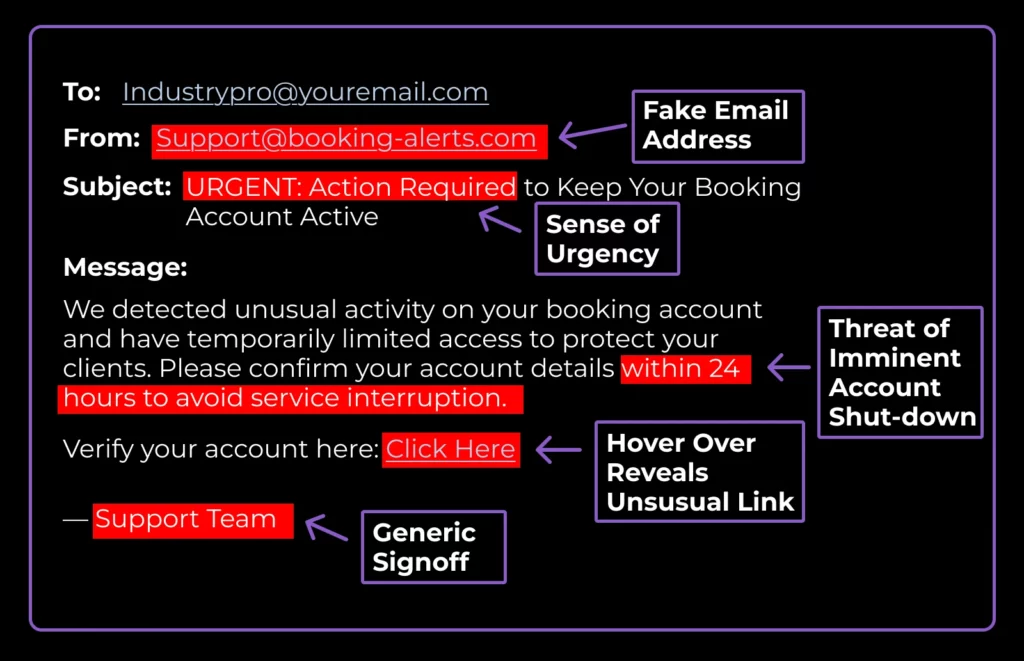
Stay vigilant regarding suspicious emails and text messages. Phishing links, which are “fake” links made to capture your private data, are a common way hackers get access to your systems.
Watch Out For:
- Urgent or threatening messages
- Requests for login details or payment information
- Unexpected attachments or links
Verify any requests through official websites or with a trusted contact. When in doubt, don’t click!
Here’s an example of a phishing message targeting beauty and bodywork professionals.
4. Limit Access to Client Data
The more people and tools that have access to client data, the higher the risk. Just like you wouldn’t share the same mascara spoolie across multiple clients, ensure limited access to only yourself and qualified staff.
Best Practices:
- Only collect client data you actually need
- Remove access for friends, family, and former staff
- Review cloud storage settings to prevent public sharing
For example, your massage therapy intake form collects relevant health information, such as injuries or areas of pain. Asking for the client’s date of birth (if you don’t serve minors and age doesn’t affect treatment), home address, or employer information isn’t necessary to provide the service. Storing it only increases your risk if that data is ever exposed.
5. Back Up Your Data
Backing up your data won’t prevent an attack, but it can prevent disruption if your business is targeted. If a device is lost, stolen, or compromised, a backup can help you restore client data and keep your business running.
Best Practices:
- Set up automatic backups for your booking software, cloud files, and devices
- Use both cloud and local storage, such as a securely stored external hard drive
- Test backups regularly
Reliable backups are essential for quick recovery after an incident and demonstrate to clients that you take their data management seriously.
What Happens if Client Data Is Breached?
There’s a lot at stake when data is breached. First and foremost, you risk losing trust in your business. After all, how would you feel about a company that allowed your private information to be exposed? Your industry relies on client confidence — without it, your reputation suffers.
A cyberattack also affects:
- Whether or not you can continue operating (and making money)
- Your chances of facing regulatory fines or penalties
- The potential for class-action lawsuits filed against you
- Your risk of violating contractual obligations (with a landlord or event)
- Your business’ overall reputational and financial health
Even a seemingly minor issue, like using a weak Instagram login, could allow an attacker to access your account and read direct messages. If they find sensitive client information, you may end up facing a lawsuit if the client decides to take legal action against you.
Defending your business against such a lawsuit takes time and money that would otherwise be spent on growing your business and doing what you love.
24-Hour Checklist: What to Do if You Suspect a Data Breach
First: Secure Everything
✔️Stop using affected systems
✔️Change passwords (email, booking, cloud)
✔️Turn on multi-factor authentication
✔️Disconnect compromised devices from Wi-Fi
Next: Figure Out What’s Affected
✔️Identify what client data may be involved
✔️Note when and where you noticed the issue
✔️Don’t delete anything yet
Then: Get Support
✔️Contact your cyber liability insurance provider
✔️Follow guidance before notifying clients
✔️Document each step
Finally: Plan Communication
✔️Decide if client notification is needed
✔️Monitor accounts for unusual activity
✔️Check backups if restoration is required
How Cyber Liability Insurance Helps Protect Your Business
Even with strong security measures in place, sometimes data breaches still occur. Cyber liability insurance is a safety net that helps your business recover if you’re targeted. With this extra support, you can continue offering services and fostering client trust.
Here’s how cyber liability insurance works:
- You add this optional coverage to your base policy, such as your cosmetology insurance or massage therapy insurance coverage
- If you experience a data breach or other cybersecurity attack, you file a claim on your policy
- Your cyber liability insurance is designed to cover costs related to the claim, for your business and any affected clients
It can cover:
- Investigating the attack
- Data breach response
- Notifying clients
- Legal defense
- Recovery support
- Credit monitoring for clients
BBI’s cyber liability coverage costs $6.58/month (added to your base policy) and is specifically tailored for solo beauty and bodywork professionals, not large tech companies, so you don’t have to pay for cybersecurity damages all on your own!
Get peace of mind to book, accept payments, and keep clients in your marketing loop with cyber liability insurance. With smart digital habits and cyber liability coverage from BBI, your clients’ data is in great hands.
How Cyber Liability Insurance Helps Protect Your Business
How Can I Keep My Client Data Safe as a Beauty or Bodywork Professional?
Focus on using strong, unique passwords, locking devices, limiting data access to yourself, and only collecting information needed to provide your services. Treat all client information with the same care and discretion you give your clients themselves.
Do Small Salons and Solo Practitioners Really Need to Worry About Data Breaches?
Yes, every salon, spa, or solo practitioner can experience data breaches, no matter how small their operations. If even one client’s data is exposed, a single data breach lawsuit can take a devastating toll on your business.
Salon insurance, enhanced with cyber liability insurance, is designed to help you recover from a costly data breach.
Is Cyber Liability Included In My BBI Policy or Is It an Add-On?
BBI’s cyber liability coverage is an optional add-on (endorsement) to your base policy. Opt in to this coverage when purchasing a new policy or any time after through your user dashboard.
See what’s automatically included in your BBI policy on our Coverage Details page.
What Should I Do if I Think My Client Data Has Been Hacked or Leaked?
If you suspect your client data has been exposed, lock your accounts, document what happened, and notify your insurer immediately. After you file a claim, an agent will walk you through the next steps of investigating the cyberattack and making things right with your affected clients.

JoAnne Hammer | Program Manager
JoAnne Hammer is the Program Manager for Beauty and Bodywork Insurance. She has held the prestigious Certified Insurance Counselor (CIC) designation since July 2004.
JoAnne understands that starting and operating a business takes a tremendous amount of time, dedication, and financial resources. She believes that insurance is the single best way to protect your investment, business, and personal assets.
JoAnne Hammer is the Program Manager for Beauty and Bodywork Insurance. She has held the prestigious Certified Insurance Counselor (CIC) designation since July 2004.
JoAnne understands that starting and operating a business takes a tremendous amount of time, dedication, and financial resources. She believes that insurance is the single best way to protect your investment, business, and personal assets.